Rock trenching is a common challenge in pipeline installation, utility construction, drainage projects, road building, and foundation work. When excavators encounter hard rock, contractors often choose between two attachments: a hydraulic breaker and an excavator drum cutter. Both attachments can break rock, but they work in different ways. Hydraulic breakers use repeated impacts to fracture hard material, while an excavator drum cutter uses rotating cutting tools to mill rock and create a more controlled trench profile.
Choosing between them can affect trench accuracy, vibration, surface finish, and the amount of follow-up work required. This guide compares the two attachments, explains their advantages for rock trenching, and helps you select the right equipment for your excavator and project. For more details, please contact YG anytime.
I: What Is a Hydraulic Breaker for an Excavator?
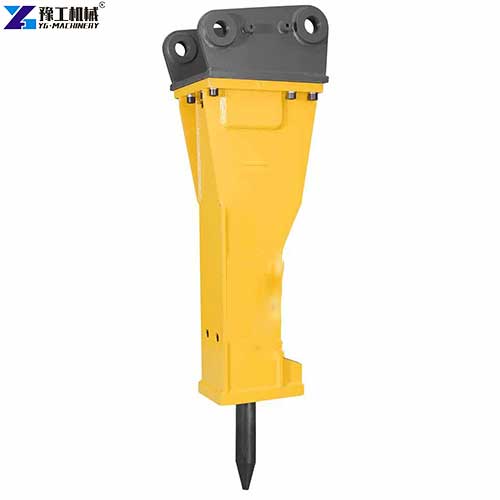
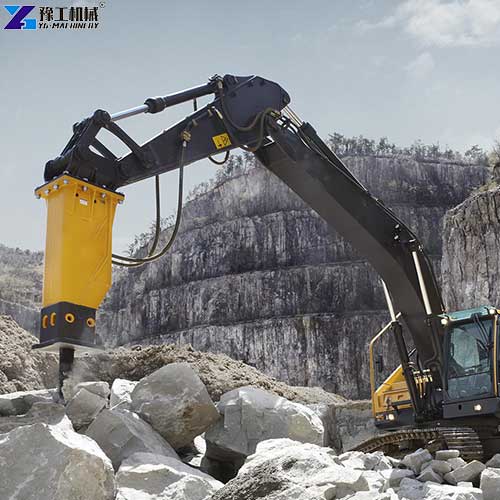
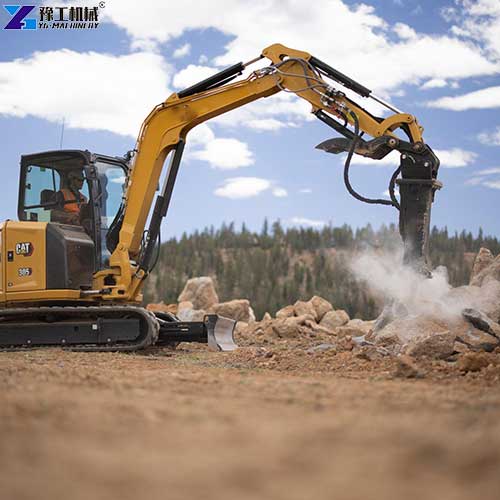
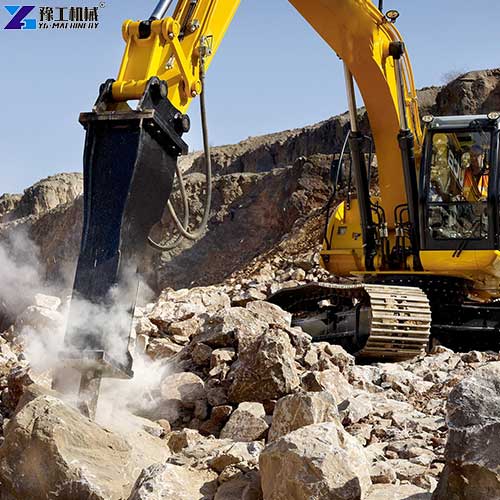
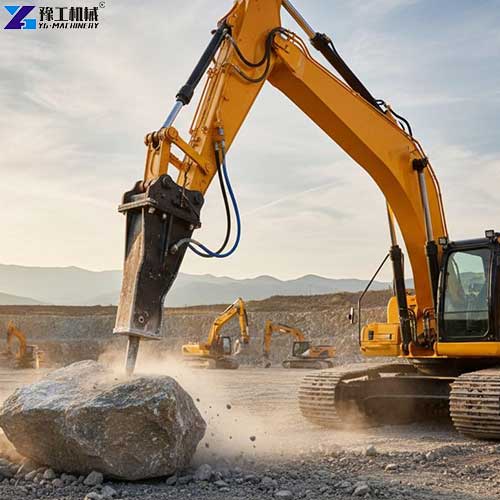
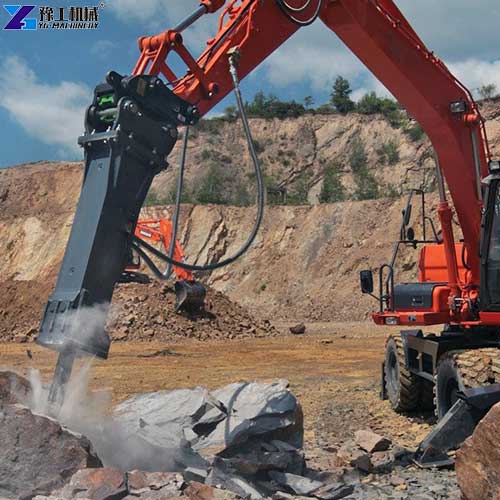
A hydraulic breaker is an excavator attachment that uses hydraulic power to drive a piston. The piston repeatedly strikes a chisel, transferring impact energy into rock, concrete, or asphalt until the material cracks and breaks apart.
A hydraulic breaker attachment is commonly used for:
- Breaking hard rock before trench excavation
- Removing concrete foundations and reinforced concrete sections
- Breaking road surfaces and old pavement
- Reducing large rock pieces into smaller fragments
- Demolition and general construction work
For rock trenching, a hydraulic breaker is particularly useful when the rock is very hard or massive, and the main goal is to fracture and remove it. The excavator can then use a bucket or another suitable attachment to clear the broken material.
YG Excavator Breakers Parameters
| Model | ChiselDiameter | SuitableCarrierWeight | Main bodyWeight | OperatingPressure | Hydraulic Oil Flow | Blow Frequency | HoseDiameter |
| mm | Ton | kg | Kg/cm 2 | I/min | bpm | inch | |
| YG350 | 35 | 0.5-1 | 40 | 90-120 | 15-25 | 800-1300 | 1/2 |
| YG400 | 40 | 1-3 | 53 | 90-120 | 15-25 | 800-1300 | 1/2 |
| YG450 | 45 | 1.2-3.0 | 67 | 90-120 | 20-30 | 700-1200 | 1/2 |
| YG530 | 53 | 2.5-4.5 | 85 | 90-120 | 25-50 | 600-1100 | 1/2 |
| YG600 | 60 | 2-5 | 140 | 90-120 | 25-50 | 600-1100 | 1/2 |
| YG680 | 68 | 4-7 | 152 | 110-140 | 40-70 | 500-900 | 1/2 |
| YG750 | 75 | 6-9 | 210 | 120-150 | 50-90 | 400-800 | 1/2 |
| YG850 | 85 | 7-14 | 278 | 130-160 | 60-100 | 400-800 | 3/4 |
| YG1000 | 100 | 10-15 | 475 | 150-170 | 80-110 | 350-700 | 3/4 |
| YG1250 | 125 | 15-18 | 616 | 150-170 | 80-110 | 350-700 | 3/4 |
| YG1350 | 135 | 16-26 | 846 | 160-180 | 130-150 | 400-800 | 1 |
| YG1400 | 140 | 18-26 | 916 | 160-180 | 120-180 | 350-500 | 1 |
| YG1400A | 140 | 18-26 | 952 | 160-180 | 120-180 | 350-500 | 1 |
| YG1500 | 150 | 27-35 | 1088 | 160-180 | 150-190 | 350-700 | 1 |
| YG1550 | 155 | 28-36 | 1309 | 180-200 | 200-260 | 250-400 | 1-1/4 |
| YG1650 | 165 | 30-40 | 1438 | 180-200 | 200-260 | 250-400 | 1-1/4 |
| YG1650P | 165 | 30-40 | 1586 | 180-200 | 200-260 | 250-380 | 1-1/4 |
| YG1750 | 175 | 35-40 | 1929 | 180-200 | 210-290 | 200-350 | 1-1/4 |
| YG1850 | 185 | 35-45 | 2411 | 190-220 | 220-270 | 200-250 | 1-1/4 |
| YG1990 | 190 | 40-55 | 2626 | 190-220 | 220-290 | 180-200 | 1-1/4 |
| YG2100 | 210 | 60-80 | 3396 | 200-240 | 290-350 | 150-200 | 1-1/4 |
Advantages of a Hydraulic Breaker for Rock Trenching
- Strong impact for hard materials: A breaker delivers repeated impacts to a concentrated area. This makes it useful for fracturing hard rock and breaking large, solid sections that are difficult to remove with a conventional bucket.
- Suitable for different breaking jobs: A breaker can be used for rock, concrete, and asphalt, provided the model and chisel are suitable for the material. Contractors can use the same attachment across compatible demolition and excavation tasks.
- Useful for preliminary rock breaking: When a trench passes through large, hard rock, a breaker can fracture the material before it is removed. This can be a practical approach where precise milling is less important than breaking the rock into manageable pieces.
II: What Is a Milling Head for Excavator?
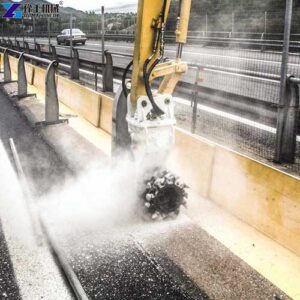
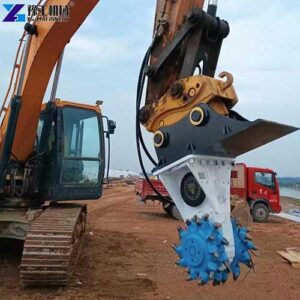
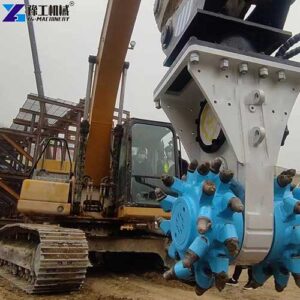
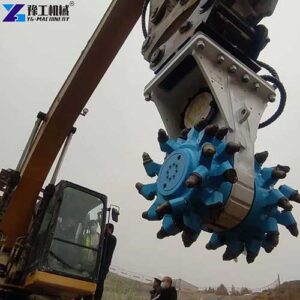
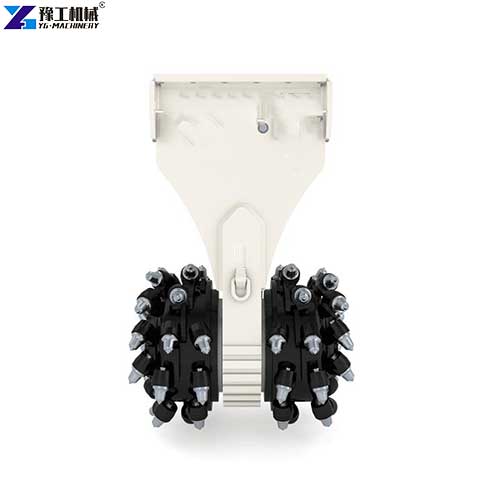
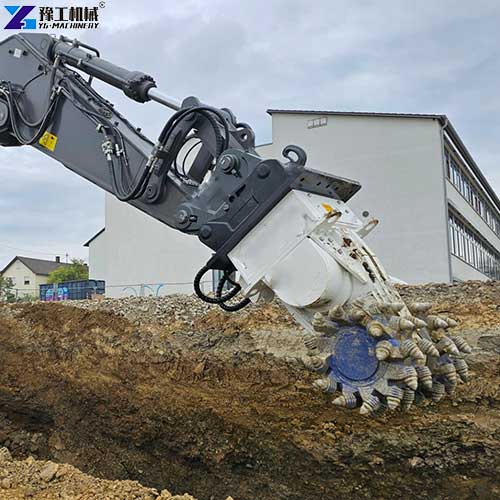
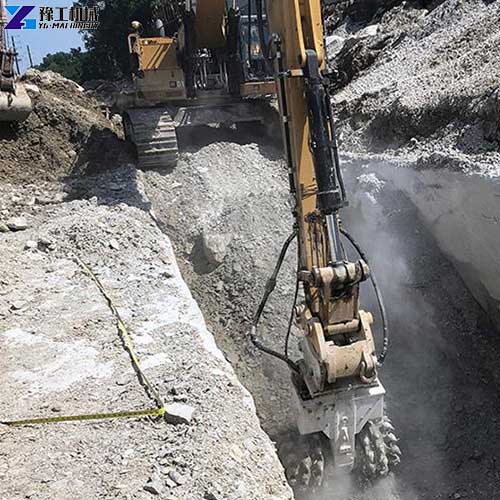
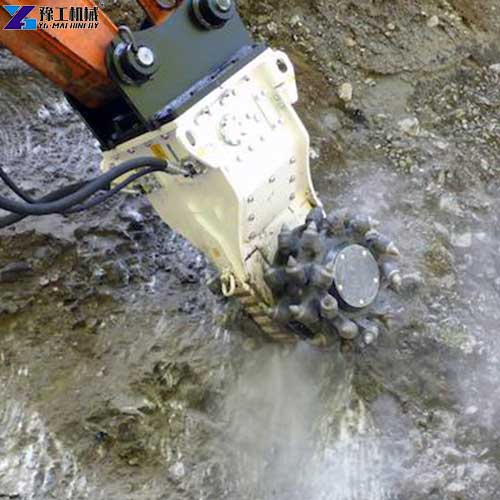
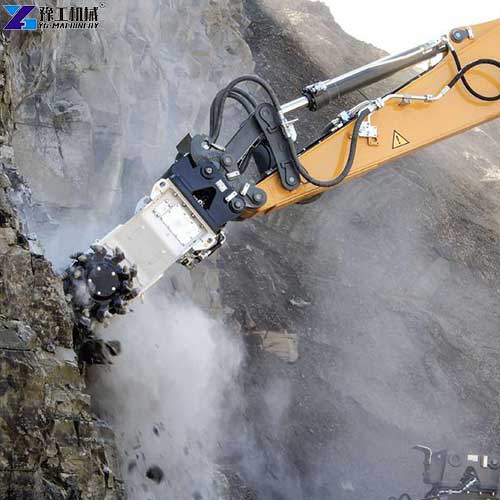
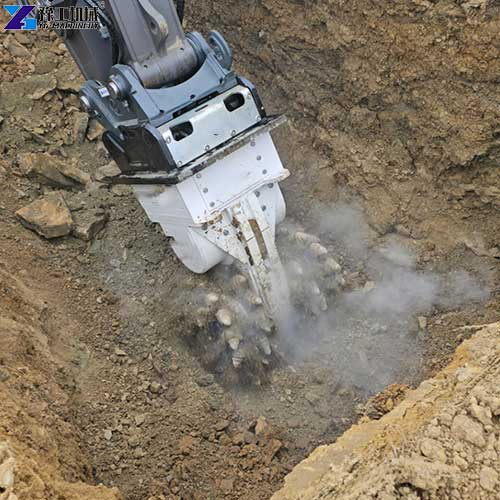
A milling head for excavator is a hydraulic attachment with a rotating cutting drum fitted with multiple cutting picks or teeth. Driven by a hydraulic motor, the drum rotates and mills the material as the excavator moves the attachment along the working area.
Unlike a hydraulic breaker, which fractures rock through repeated impacts, a drum cutter removes material through continuous rotary cutting.
An excavator drum cutter is commonly considered for:
- Rock trenching for water, gas, and utility pipelines
- Narrow channels and drainage trenches
- Rock excavation in urban construction areas
- Shaping rock surfaces and excavated profiles
- Milling concrete and other suitable materials with the correct cutting tools
Milling Head Attachment for Excavator
| Parameter Items | YG-060 | YG-150 | YG-200 | YG-350 | YG-450 | Dual-motor Milling Machine |
| Applicable Models | Within 6T | 8-18T | 20-35T | 30-40T | 40-50T | 20-35T |
| Total Weight (kg) | 270 | 650 | 1000 | 1550 | 1800 | 700 |
| Milling Width(mm) | 450 | 680 | 720 | 950 | 1050 | 745 |
| Milling Head Diameter (mm) | 370 | 470 | 510 | 650 | 650 | 470 |
| Number of Blades | 44 | 44 | 44 | 44-66 | 44-66 | 44 |
| RPM(r/min) | 0-150 | 0-100 | 0-85 | 0-75 | 0-75 | 75 |
| Traffic(L/min) | 40-60 | 120 | 200 | 320 | 380 | 200 |
| Maximum Pressure (MPa) | 30 | 30 | 30 | 30 | 30 | 30 |
| Maximum Torque (N.m) | 1500 | 6300 | 10600 | 23300 | 25000 | 10000 |
Advantages of an Excavator Drum Cutter for Rock Trenching
- More controlled cutting: The rotating drum mills the material instead of relying on repeated impact. This can help contractors create a more controlled trench shape, particularly where the trench width and profile matter.
- Suitable for narrow trenches: Rock trenching for utilities often requires a defined width and depth. A suitable rotary drum cutter can mill along the planned route, helping limit unnecessary excavation outside the required trench.
- Potentially lower vibration: Because the drum cutter uses rotary cutting rather than repeated hammer impacts, it may produce less impact-related vibration. This can be valuable near existing buildings, buried utilities, or other sensitive structures. Actual vibration depends on the material, attachment, and operating method.
- A milled surface: A drum cutter can produce a more even milled surface than impact breaking in suitable materials. This may reduce the amount of secondary shaping needed, although some trenches still require cleanup or trimming.
III: Excavator Drum Cutter vs. Hydraulic Breaker: Key Differences
The two attachments are designed for different working methods. A hydraulic breaker is primarily a rock-fracturing tool, while a rotary drum cutter is a milling tool.
| Comparison | Hydraulic Breaker Attachment | Excavator Drum Cutter |
| Working principle | Repeated piston impacts strike a chisel to fracture material | A hydraulic motor rotates a drum with cutting teeth to mill material |
| Main strength | Breaking hard, solid rock and concrete | Controlled milling and shaping of rock |
| Rock trenching | Useful for fracturing large or very hard rock before excavation | Useful for cutting a defined trench in suitable rock conditions |
| Trench profile | May leave irregular edges and broken surfaces | Can provide a more controlled profile when properly selected and operated |
| Vibration | Repeated impacts can generate significant vibration | Usually avoids the repeated impact pattern of a breaker; actual vibration varies |
| Material removal | Breaks rock into fragments that must be excavated | Mills material into cuttings or smaller fragments that must also be removed |
| Typical working tool | Chisel or moil point | Rotating drum with cutting picks |
| Carrier size | Supplied range includes 0.5–80 tons across different models | Supplied range includes 6–50 tons across different models |
| Best-fit job | Breaking large rock, concrete, and other hard material | Trenching, milling, and controlled rock excavation |
| Main selection concern | Carrier compatibility, hydraulic flow, pressure, and breaking requirements | Carrier compatibility, hydraulic flow, pressure, torque, cutting width, and rock conditions |
IV: Which Attachment Is Better for Different Rock Trenching Jobs?
The best attachment depends on the rock, trench design, nearby structures, and required production method.
Scenario 1: Trenching Through Very Hard Rock
Recommended option to evaluate: Hydraulic breaker
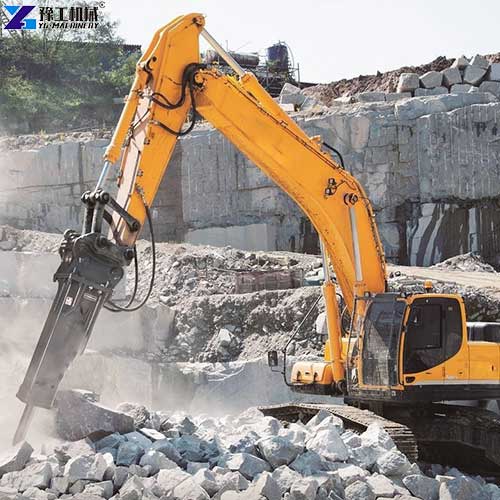
If the trench passes through massive, hard rock, a hydraulic breaker may be suitable for fracturing the material into removable pieces. The excavator can then clear the fragments with a bucket.
A breaker is especially worth considering when:
- The rock is very hard and difficult to mill efficiently.
- Large rock sections need to be fractured before removal.
- The trench does not require a particularly smooth or precise rock profile.
- The contractor also needs the attachment for general rock breaking or concrete demolition.
The final selection should be based on the rock’s strength, fracture patterns, excavator capability, and required breaking output.
Scenario 2: Narrow Utility Trenching
Recommended option to evaluate: Excavator drum cutter
For utility trenches, contractors may need a controlled width and a defined route for water pipes, drainage lines, electrical cables, or other services.
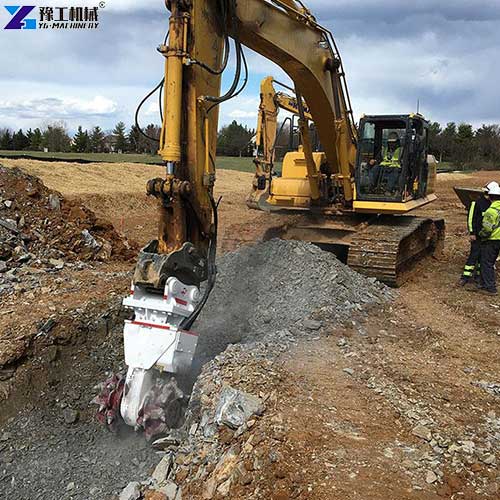
A suitable drum cutter can mill along the planned trench line and may reduce unnecessary breaking outside the target area.
It is worth considering when:
- Trench width needs to be controlled.
- Nearby structures or buried services require careful excavation.
- A more even milled surface is desirable.
- The material can be cut effectively with the selected drum and teeth.
Before starting, confirm the location of buried utilities and make sure the attachment’s cutting width and excavator reach suit the design.
Scenario 3: Rock Trenching Near Existing Buildings
Recommended option to evaluate: Excavator drum cutter
Repeated hammer impacts can be a concern near sensitive structures. A drum cutter may offer an alternative by milling the material through rotation rather than repeated high-energy impacts.
However, a drum cutter is not vibration-free. Site conditions, rock properties, attachment settings, and machine operation still affect vibration. Where structural protection is critical, contractors should assess vibration limits and monitor the work as required.
Scenario 4: Concrete Trenching and Demolition
Both attachments may be suitable, depending on the job.
A concrete breaker for an excavator is useful when the aim is to fracture a thick concrete section or remove large pieces. A drum cutter may be preferable when milling or controlled surface removal is required, and the material is suitable for cutting.
V: How to Choose the Right Attachment?
Use the following checklist before making a purchasing decision.
| Selection factor | Choose a hydraulic breaker when… | Choose a drum cutter when… |
|---|---|---|
| Main objective | You need to fracture and break hard material | You need to mill or shape material |
| Rock condition | Large, hard sections need impact breaking | The rock can be cut effectively with suitable teeth |
| Trench accuracy | Irregular fracture is acceptable or secondary excavation is planned | A controlled trench profile is important |
| Vibration requirements | Impact-related vibration is acceptable within site limits | Reducing repeated impact may be beneficial |
| Additional applications | You need a general-purpose breaking attachment | You regularly perform trench milling, shaping, or surface cutting |
| Hydraulic compatibility | The excavator matches the breaker’s flow and pressure requirements | The excavator matches the cutter’s flow, pressure, torque, and power requirements |
Match the Attachment to Your Excavator
For a hydraulic breaker, check the carrier weight, chisel diameter, hydraulic oil flow, operating pressure, and blow frequency.
For a drum cutter, check the carrier weight, hydraulic oil flow, maximum pressure, drum diameter, milling width, and torque.
Do not choose a drum cutter or breaker based only on excavator tonnage. Two excavators with similar operating weights can have different hydraulic capacities.
VI: 4 FAQs about YG Excavator Breakers vs. Excavator Drum Cutter for Rock Trenching
Neither is always better. A hydraulic breaker is suited to fracturing hard material, while an excavator drum cutter is suited to milling and controlled excavation in compatible rock. The best option depends on rock conditions, trench accuracy, and the excavator’s hydraulic capacity.
Not in every job. A breaker is often more suitable for fracturing thick concrete or large concrete blocks. A drum cutter may be better for controlled milling or shaping. Reinforced concrete may also require separate methods to deal with steel reinforcement.
Check the excavator’s operating weight, hydraulic flow, operating pressure, mounting dimensions, hose size, and the material you plan to break. Make sure the selected model falls within the carrier manufacturer’s limits.
Confirm the carrier’s hydraulic flow and pressure, available power and torque, attachment weight, drum diameter, cutting width, and the type of material to be milled. Ask the supplier whether the cutter is suitable for your rock conditions and trench requirements.
Find the Right Excavator Attachment for Your Project
Rock trenching requires the right balance between breaking force, cutting control, working efficiency, and excavator compatibility.
A hydraulic breaker is a practical option when your main task is to fracture hard rock or concrete. An excavator drum cutter is worth considering when the job calls for controlled milling, trench shaping, or a more even cut in suitable material.
YG Machinery offers different hydraulic breaker and drum-cutter models for different excavator sizes and working requirements.
Contact YG Machinery with your excavator model, operating weight, hydraulic flow, hydraulic pressure, rock type, and required trench dimensions. Our team can help you compare a suitable hydraulic breaker attachment with a rotary drum cutter for your project.
Contact YG Machinery today to find the right excavator attachment for your next rock trenching job.