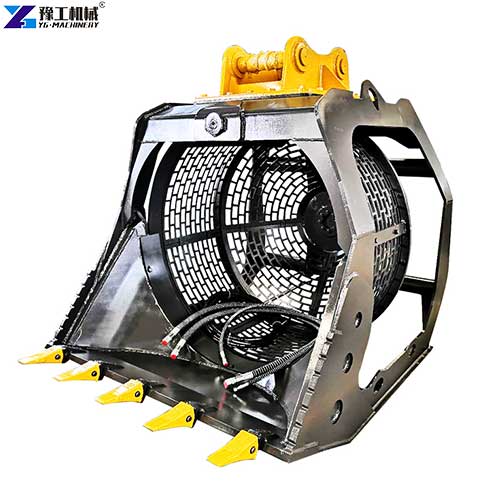
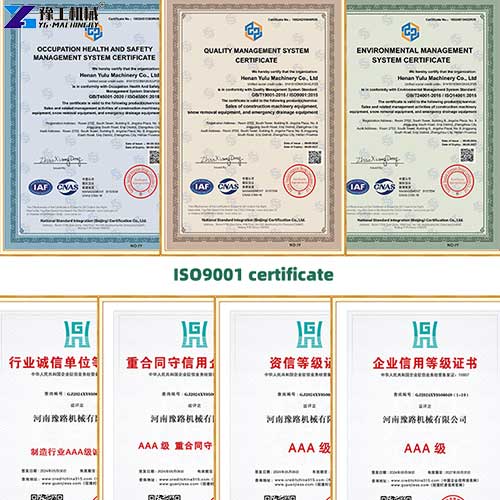
When working with soil, sand, gravel, demolition waste, or mixed materials, not every bucket can complete the job efficiently. Sometimes, the material you dig up contains stones, roots, concrete pieces, or other unwanted materials that need to be separated before reuse.
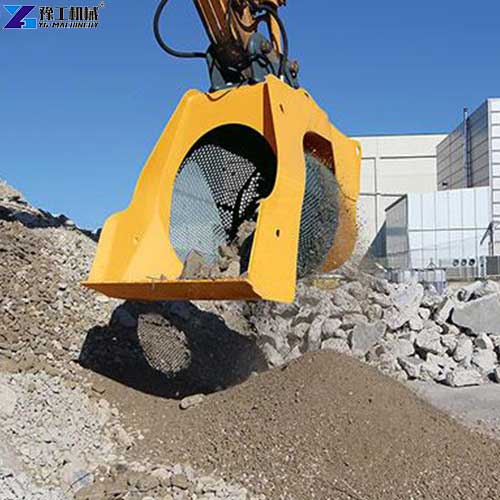
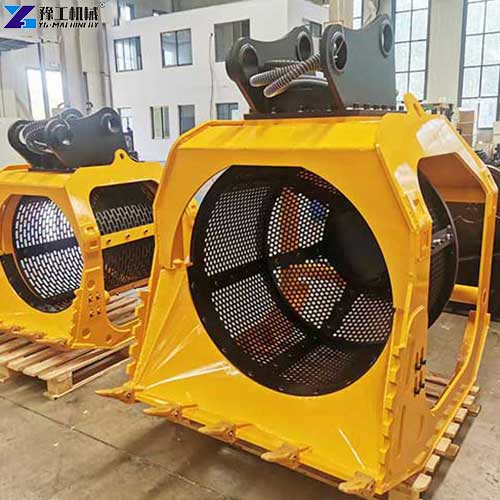
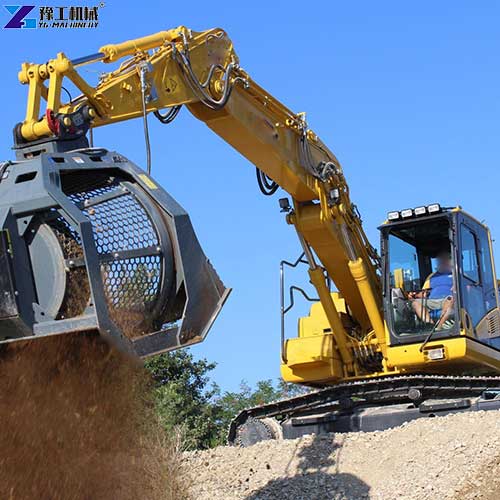
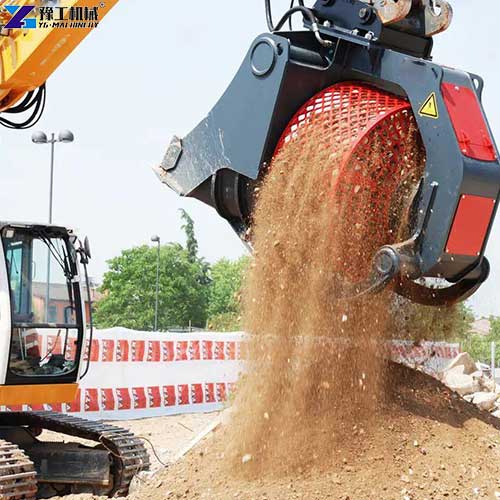
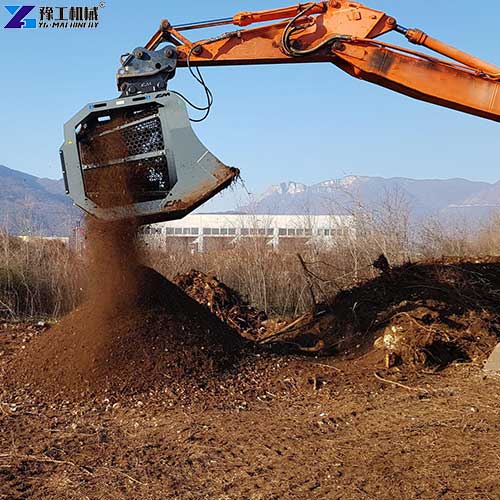
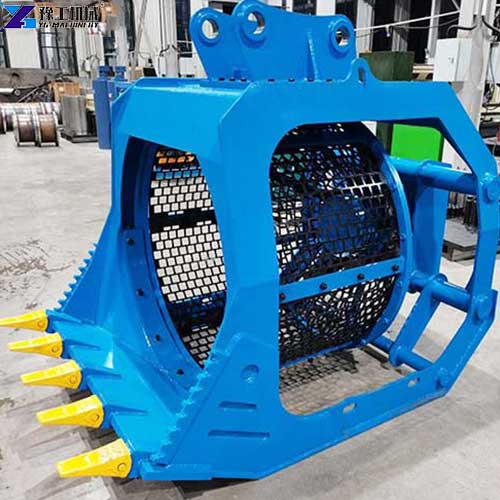
A rotary screening bucket offers a practical solution. The attachment mounts on the excavator’s stick just like a bucket. Inside the drum, material is tumbled and separated by size through interchangeable screen panels. Fine material falls through the mesh. Oversized material exits the other end. The operator loads, screens, and places — all in one continuous motion.
Get 12-Month Warranty & 24/7 Technical Support – Learn More
Rotary Screening Bucket Parameters
| Product Model | YGGTS-03 | YGGTS-06 | YGGTS-12 | YGGTS-16 | YGGTS-20 | YGGTS-24 | YGGTS-30 |
| Applicable Models (t) | 5-10 | 10-18 | 18-25 | 20-30 | 25-35 | 30-40 | 40-50 |
| Machine Weight (kg) | 500 | 950 | 1320 | 1800 | 2000 | 2800 | 4000 |
| Hopper Capacity (m³) | 0.3 | 0.6 | 1.2 | 1.6 | 2 | 2.4 | 3 |
| Working Pressure (MPa) | 20 | 20 | 20 | 20 | 20-25 | 20-25 | 20-25 |
| Recommended Flow Rate (L/min) | 60 | 80 | 100 | 100 | 150 | 150 | 220 |
| Sieve Aperture (mm) | 5-50 | 5-80 | 5-100 | 5-120 | 20-120 | 20-120 | 20-120 |
Get 12-Month Warranty & 24/7 Technical Support – Learn More
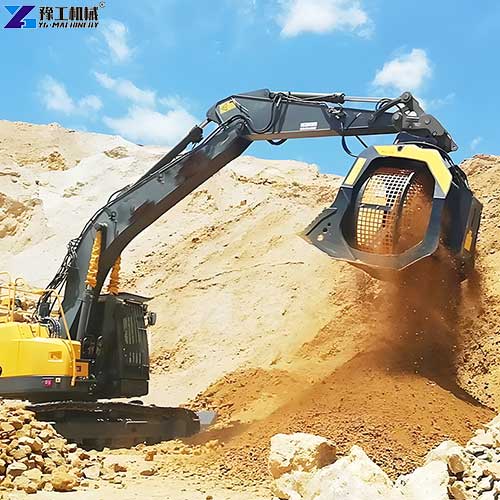
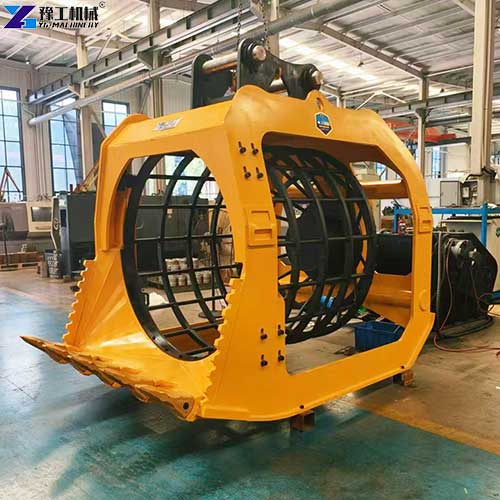
How a Rotary Screening Bucket Works? 8 Steps
The rotary screening bucket operates on a straightforward yet effective principle:
- The drum is hydraulically driven by the excavator’s auxiliary hydraulic circuit, spinning at high speed
- Two forces work in combination: centrifugal force from the rotation, and screening action from the mesh panels
- Mixed material is loaded into the drum, where the rotating motion continuously tumbles it
- The drum wall features wear-resistant mesh panels with different aperture sizes — particles are classified by size
- Fine material passes through the mesh openings and falls out below the drum
- Coarse material is carried along inside the drum and discharged from the rear end via an internal deflector plate
- The entire process is fully automatic — waste is removed, and useful aggregate is recovered simultaneously
- No external power source is needed; the excavator screening bucket runs entirely on the excavator’s existing hydraulic system
9 Key Features of a Rotary Screening Bucket
Here are the main advantages of a rotary screening bucket:
- Interchangeable mesh panels: Multiple aperture sizes allow the same machine to handle fine topsoil screening, sand grading, and coarse gravel separation — just swap the panel
- Quick panel replacement: Mesh panels can be removed and replaced rapidly, minimizing downtime between different screening tasks
- High screening efficiency: The optimized drum structure rotates smoothly without jamming, ensuring consistent output even with wet or sticky materials
- Stable operation, low failure rate: Simple mechanical design means fewer breakdowns and longer service life
- Low operating cost: Daily maintenance requires only basic cleaning and lubrication — no complex servicing needed
- No extra power source required: Mounted directly on the excavator’s arm, powered by the machine’s own hydraulic system — zero additional fuel or equipment costs
- Multi-function in one unit: Excavating, screening, and loading are all completed simultaneously by a single machine
- Dramatically reduces equipment investment: One excavator with screening attachments for excavators replaces what would normally require a loader, a screen plant, and a conveyor
- Compact and mobile: Goes wherever the excavator goes — ideal for tight or remote sites where a standalone screen plant can’t reach
Get 12-Month Warranty & 24/7 Technical Support – Learn More
Which Attachments Work Best with a Rotary Screening Bucket?
A rotary screening bucket is most powerful when combined with other excavator attachments in a multi-stage workflow. Here’s how different attachments work together:
| Attachment combination | Suitable work | How the combination works | Main benefit |
|---|---|---|---|
| Rotary screening bucket + hydraulic breaker hammer | Concrete demolition, rock removal, renovation | The breaker first breaks suitable concrete or rock into smaller pieces. The screening bucket then separates suitable soil-like material and smaller fragments from oversized debris. | Helps organize demolition material for reuse, further processing, or disposal. |
| Rotary screening bucket + crusher bucket | Concrete recycling, construction waste processing | The crusher bucket reduces suitable oversized material. The screening bucket then separates material according to screen size. | Provides a practical crushing-and-screening workflow when the output requirements and material are suitable. |
| Rotary screening bucket + excavator grapple | Demolition cleanup, site clearance, mixed waste handling | The grapple picks up and removes large objects, branches, or selected debris. The screening bucket processes the remaining suitable soil or material mixture. | Reduces large unwanted objects in the feed material and makes subsequent screening easier. |
| Rotary screening bucket + excavator ripper | Hard ground, compacted soil, weathered rock | The ripper loosens compacted ground or suitable rock before the screening bucket separates the excavated material. | Makes difficult material easier to excavate and prepares suitable material for screening. |
| Rotary screening bucket + rock saw | Rock cutting, trenching, selected demolition work | The rock saw makes controlled cuts where the project requires them. Excavated material can then be handled and screened where appropriate. | Helps separate cutting and material-processing tasks for better site organization. |
| Rotary screening bucket + standard digging bucket | General earthwork, site preparation, backfilling | The standard bucket performs bulk excavation and loading. The screening bucket processes selected material that needs separation. | Keeps bulk excavation and material grading flexible without relying on one attachment for every task. |
| Rotary screening bucket + auger attachment | Landscaping, fencing, planting, selected foundation work | The auger drills holes for posts or planting. The screening bucket can separately prepare suitable soil or remove larger debris from excavated material. | Supports two different site tasks with one excavator by changing attachments as needed. |
| Rotary screening bucket + hydraulic quick coupler | Multi-task construction and landscaping | A compatible quick coupler helps the operator switch between the screening bucket and other approved attachments. | Can reduce attachment-change time and make the excavator more flexible across different tasks. |
The key advantage: by combining screening attachments for excavators with other tools, a single excavator can perform the work of an entire mobile processing plant — at a fraction of the cost and with far less site disruption.
Get 12-Month Warranty & 24/7 Technical Support – Learn More
5 Application of Rotary Screening Bucket
- Landscaping and topsoil preparation: Remove suitable stones, roots, and larger debris from excavated soil before using it for planting, lawn preparation, or green-space restoration. This can help contractors prepare more uniform soil without moving every load to a separate screening area.
- Construction and demolition: Screen mixed soil and selected demolition materials to separate reusable fine material from larger fragments. Materials that contain metal, hazardous substances, or unsuitable contaminants still require appropriate handling and sorting.
- Road construction and trench backfilling: Separate suitable excavated material before using it for trench backfill or other earthwork. The screened material must meet the project’s engineering specifications; screening alone does not guarantee that soil is suitable for every structural application.
- Agriculture and composting: Screen suitable compost, organic matter, or soil to remove larger unwanted pieces. The best results depend on moisture, material consistency, and the type of screen used.
- Quarrying and material recycling: Screen selected gravel, crushed stone, and other suitable materials before reuse or additional processing. For large, continuous production volumes, compare the bucket’s practical throughput with that of a dedicated screening plant.
Get 12-Month Warranty & 24/7 Technical Support – Learn More
Customer Case Study 1 — United States: Landscaping Contractor in Colorado
- Background: Rocky Mountain Landscaping, based near Denver, Colorado, specializes in residential and commercial landscape installation. The company handles approximately 40–50 projects per year, ranging from small backyard renovations to large commercial grounds development.
- The Problem: Their biggest recurring challenge was topsoil. Many properties had existing soil that was usable but full of rocks, roots, and debris. The company was ordering in pre-screened topsoil for every project — for $35–50 per cubic yard delivered. For large projects requiring 100+ cubic yards, this was a significant line item. They also had excavated spoil from grading work that was being hauled away at $20–30 per ton — material that could have been reused if it was properly screened.
- The Solution: The company purchased an excavator screening bucket for sale from YG Machinery — a mid-size rotary screening bucket with interchangeable screen panels (20mm and 40mm mesh). Mounted on their existing 20-ton excavator, the screening bucket went to work immediately.
- The Results:
| Metric | Before Using Rotary Screening Bucket | After Using Rotary Screening Bucket | Change |
|---|---|---|---|
| Topsoil purchased (per project) | 100% imported | ~30% imported | -70% cost |
| Spoil hauling costs | $1,500–3,000/project | $200–500/project | -80% |
| Topsoil processing time | N/A (delivered ready) | 1–2 hours on-site | Minimal disruption |
| Annual material cost savings | — | $45,000–60,000 | Significant |
Customer Feedback:
“We were spending a fortune on imported topsoil and paying to haul away material we were digging up. The YG rotary screening bucket changed everything. Now we screen the material we already have on-site. The 20mm panel gives us perfect topsoil for turf installation. The 40mm panel handles our backfill screening. We recovered the attachment cost in about four months just from material savings alone.”
— Brian Kowalski, Owner, Rocky Mountain Landscaping
Get 12-Month Warranty & 24/7 Technical Support – Learn More
Customer Case Study 2 — Africa: Gold Mining Operation in Ghana
- Background: A small-scale gold mining operation near Tarkwa, Ghana, processes alluvial deposits along river beds. The operation uses a combination of excavators and sluice boxes to extract gold from gravel and sandy deposits.
- The Problem: The raw material contained a wide range of particle sizes — from fine clay to large boulders. Their sluice system worked best with material in the 5–25mm range. Anything larger was wasted; anything finer than 5mm was being lost in the water system without being processed properly. They were using a separate vibrating screen plant to pre-sort material — but it required a generator, additional fuel, maintenance, and two dedicated workers to operate. On a remote riverbed site, logistics were complicated, and costs were high.
- The Solution: The operation purchased a heavy-duty rotary screening bucket from YG Machinery — equipped with a custom 20mm screen panel to produce the ideal feed size for their sluice system. Mounted on their 30-ton excavator, the screening bucket processed material directly from the deposit and placed screened feed into the sluice hopper.
- The Results:
| Metric | Before (Separate Screen Plant) | After (Rotary Screening Bucket) | Change |
|---|---|---|---|
| Equipment required | Excavator + screen plant + generator | Excavator only | -2 machines |
| Workers needed | 4 (excavator + screen plant) | 1 (excavator operator) | -75% labor |
| Fuel consumption | Excavator + generator | Excavator only | -40% fuel |
| Daily throughput | 80–100 m³ | 100–130 m³ | +25% |
| Gold recovery rate | Baseline | Improved (consistent feed size) | Higher |
| Maintenance cost | Screen plant + generator maintenance | Drum panel replacement only | -60% |
Customer Feedback:
“We used to run a separate screening plant with its own generator and two workers. It broke down often, and getting spare parts to our river bed site was a nightmare. The YG excavator screening bucket replaced the entire system. One operator, one excavator, and we’re screening more material per day than before. The 20mm panel gives us exactly the feed size our sluices need. When the panel wears out, we just swap it — no complex maintenance. For small-scale mining operations like ours, this excavator screening bucket is the best investment we’ve made.”
— Kwame Asante, Operations Manager, Tarkwa Alluvial Mining Co.
Factory Direct Rotary Screening Bucket-Contact YG for a Free Quote
Whether you’re a landscaping contractor looking to reduce material costs, a mining operator needing efficient on-site screening, or a recycling facility processing demolition waste, YG Machinery offers screening attachments for excavators designed for real-world performance.
What YG provides:
Multiple drum sizes to match your excavator tonnage (5T to 50T)
Custom mesh sizes available for specific applications
Heavy-duty wear-resistant construction for demanding environments
Hydraulic motor sized for consistent drum rotation under load
Quick coupler compatible for fast attachment changes
Complete spare parts package (screen panels, hydraulic hoses, wear liners)
Contact YG Machinery with your excavator model and screening requirements — material type, target particle size, and daily volume — and we’ll recommend the right rotary screening bucket configuration for your operation.