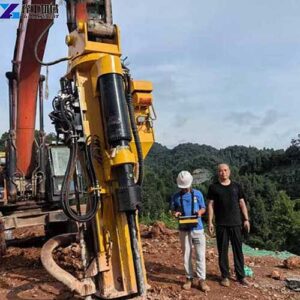
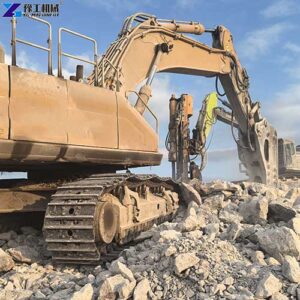
Breaking hard rock on a construction site can quickly become one of the most difficult parts of a project. Traditional excavation methods may take a long time, while using several machines for drilling and splitting can increase labor, transportation, and coordination costs. For one construction contractor in the Philippines, this was exactly the problem. The company needed a practical solution for hard-rock excavation on a developing construction site. After checking different options, the customer selected the YG-130 integrated hydraulic rock drill and splitter, an excavator-mounted system that combines drilling and rock splitting in one machine. This story shares the customer’s experience, from the original challenge to equipment selection, delivery, project operation, and final results. Want to know more detailed product information? Contact YG now!
A Growing Philippine Construction Company
The client is a Philippine-based construction contractor with years of experience in local construction projects. Their core business includes foundation excavation, road construction, land development, utility trenching, site preparation, rock excavation, and small infrastructure projects. As their business grew, the company began taking on more projects located in areas with hard rock near the surface. This presented new challenges. The client’s existing excavators could handle soil, loose gravel, and general excavation work, but excavating hard rock was significantly more difficult.
The project manager explained:
“We have excavators, but our efficiency drops significantly when we encounter hard rock.”
It was in this context that the company approached YG to learn about integrated hydraulic rock drills and rock splitters.
Hard Rock Was Holding Everything Back
The customer’s latest project required excavation for a new commercial development. The site had several sections of hard rock that needed to be broken before the foundation and utility work could continue. The company faced four major problems.
- Slow Rock Excavation: The conventional excavator bucket could not efficiently remove large sections of hard rock.
- Difficult Rock Control: The contractor wanted to break the rock in a controlled manner instead of using methods that could create excessive impact around the excavation area.
- Limited Equipment: Bringing separate drilling and rock-breaking equipment to the site would increase transportation and coordination requirements.
- Tight Project Schedule: The customer had already planned the next construction stages. If rock excavation was delayed, the entire project schedule could be affected.
Why the YG-130 Integrated Hydraulic Rock Drill And Splitter Was the Right Match?
The customer’s excavator was in the 30T class.
This matched the recommended excavator range of the YG-130.
The YG-130 weighs approximately 4,200 kg and measures about 4210 × 1400 × 1785 mm.
For this project, the contractor considered the YG-130’s size and working range more suitable than choosing a larger model.
The customer also paid close attention to the hydraulic requirements.
The YG-130 has:
- Maximum hydraulic pressure: 35 MPa
- Minimum hydraulic flow: 240 L/min
- Maximum drilling thrust force: 50 kN
- Maximum drilling pull force: 32 kN
- Maximum splitting thrust force: 160 kN
- Maximum splitting pull force: 100 kN
After confirming the excavator’s hydraulic specifications, the customer decided to proceed.
What Exactly Does the YG-130 Integrated Hydraulic Rock Drill And Splitter Do?
The YG-130 is designed to combine two important operations:
Drilling + Rock Splitting
Instead of drilling with one machine and then bringing another machine for the next stage, the integrated system allows the contractor to perform both operations using one excavator-mounted solution.
Its basic working process is:
Position → Drill → Prepare → Split → Remove Rock → Repeat
This simple workflow was one of the biggest attractions for the Philippine contractor.
Want More Case Studies? Contact YG For Customized Services.
Integrated Hydraulic Rock Drill and Splitter Parameters
| Model | YG-130 | YG-152 | YG-210 |
| Suitable Excavator | 20T-36T Excavator | 36T-48T Excavator | 48T-65T Excavator |
| Maximum Horizontal Splitting Height | 9475mm | 9985mm | 10680mm |
| Maximum Vertical Splitting Height | 6715mm | 6905mm | 6770mm |
| Maximum Splitting Depth | 6705mm | 7025mm | 8050mm |
| Maximum Splitting Distance | 10225mm | 10875mm | 11640mm |
| Pilling Beam Length | 3875mm | 4850mm | 5525mm |
| Drilling Advance Stroke | 2000mm | 2600mm | 3500mm |
| Maximum Drilling Thrust Force | 50KN | 50KN | 50KN |
| Maximum Drilling Pull Force | 32KN | 32KN | 32KN |
| Piling Advance Stroke | 1500mm | 1800mm | 2300mm |
| Maximum Piling Thrust Force | 160KN | 160KN | 160KN |
| Maximum Piling Full Force | 100KN | 100KN | 100KN |
| Hydraulic Pressure | Max. 35Mpa | Max. 35Mpa | Max. 35Mpa |
| Hydraulic Flow | Min. 240L/min | Min. 240L/min | Min. 240L/min |
| Weight | 4200kg | 6200kg | 8300kg |
| Dimensions | 4210*1400*1785mm | 5270*1485*1840mm | 5810*1485*1840mm |
| Operation Mode | Remote Control | Remote Control | Remote Control |
Want More Case Studies? Contact YG For Customized Services.


4 Practical Benefits of Using an Excavator Drill And Splitting Machine
1. Rock Excavation Became About 26% Faster
Before purchasing the machine, the contractor estimated that the hard-rock excavation stage would require approximately 15 working days. After using the YG-130, the main rock-breaking operation was completed in approximately 11 working days. That represented an estimated 26% improvement in project speed. The customer was particularly pleased because the time saved allowed the following construction stage to start earlier. Instead of waiting several additional days for rock excavation to finish, the company could move forward with foundation preparation and site work.
2. Equipment Coordination Time Fell by Around 30%
The contractor also compared the new workflow with his previous method. Previously, separate equipment could be required for different stages of rock excavation. That meant more transportation, more scheduling, more equipment coordination, more waiting, and more communication between operators. After introducing the hydraulic rock drill and splitter, the company estimated that equipment coordination time decreased by approximately 30%. The workflow became simpler. The excavator could remain on the project while the integrated system handled the drilling and splitting stages.
3. Labor Pressure Was Reduced
The contractor also noticed an improvement in workforce organization. Instead of coordinating multiple machines and operators for every stage, the company could focus the main rock operation around the excavator equipped with the YG-130. The customer estimated that labor hours associated with equipment coordination and rock-breaking preparation were reduced by approximately 22%.
4. Estimated Project Cost Savings Reached 15%
The customer also calculated the overall financial impact.
The savings came from several areas:
- Less Equipment Coordination: Fewer separate equipment movements were required.
- Reduced Labor Hours: Less time was spent coordinating the drilling and breaking stages.
- Faster Completion: The project required fewer working days.
- Lower Waiting Time: The contractor spent less time waiting for another machine to arrive.
- Better Equipment Utilization: The excavator could remain active throughout more stages of the operation.
Based on the customer’s internal calculation, the overall rock-excavation-related cost was approximately 15% lower than the original estimate.
Want More Case Studies? Contact YG For Customized Services.


Why the Customer Preferred an Integrated Solution?
Before the project, the contractor had considered using separate drilling and breaking equipment.
But after comparing the options, he preferred an integrated hydraulic rock drill and splitter.
The reason was simple.
He wanted to reduce the number of machines involved in the core operation.
His workflow became:
One excavator → one integrated system → drilling → splitting → excavation
This made project management easier.
For a medium-sized contractor, reducing equipment coordination can be just as valuable as increasing machine power.
Customer Feedback: “It Saved More Than Just Time”
After using the YG-130, the customer shared his experience.
“We bought the machine because hard rock was slowing our project down. After using it, we could organize the excavation work much better.”
He continued:
“The 20-working-day delivery was important for us because we had already planned the project schedule. We did not want equipment delivery to become another delay.”
Regarding performance, he said:
“The machine was able to drill and split the rock without us having to bring completely separate equipment for every stage.”
He also mentioned the operator:
“At first, the operator needed some time to understand the best drilling pattern. After that, the workflow became much faster.”
Finally, he added:
“For our type of construction projects, having drilling and splitting together makes the operation easier to manage.”
Want More Case Studies? Contact YG For Customized Services.


Have a Similar Rock Excavation Project? Contact YG for Customized Service
If your project involves hard rock excavation for foundations, roads, utility trenches, land development, or other construction work, choosing the right equipment can have a major impact on project time and cost.
The YG-130 is designed for 20T–36T excavators, while larger YG models are available for larger excavators. Before purchasing an integrated hydraulic rock drill and splitter, it is important to confirm excavator tonnage, hydraulic flow, hydraulic pressure, rock type, required drilling depth, required splitting range, project size, and expected working schedule.
If you are looking for an integrated hydraulic rock drill and splitter or comparing an excavator drill and splitting machine for sale, send YG your excavator model, excavator tonnage, hydraulic flow, hydraulic pressure, and project details.
Have a similar hard-rock project in the Philippines or another country? Contact YG today for a suitable model recommendation and project-specific solution.